Showing posts with label Travel. Show all posts

Saturday, August 08, 2015

Peruvian Journey: Part 2 - Up to the Sacred Valley


While Lima is the capital of Peru, the heart of the country is the Sacred Valley. This is where the heart of the Inca Empire was based and that history and culture is still a source of pride for many Peruvians. The evidence of that civilization and the testament to their building prowess is easily visible at the many ruins in the valley. 

For tourists, Cusco is the gateway to the Inca ruins. The city sits more than 11,000 feet above sea level and is a quick 40 minute flight from Lima. Ticket prices are surprisingly reasonable and flights are frequent. LAN provides the most mainstream service with the best planes. Other airlines like StarPeru and Peruvian (which I flew) provide decent service and lower prices... but with a few trade offs. For example, this is a fine specimen of a 737-200 has been around for quite a while. It may very well be as old as I am. 

Once in Cusco, the most sensible thing to do is leave, immediately. It is not that the town is a bad plus, but the the high altitude is likely to have an impact. 11,000 feet up is the same as standing on top of Mount Hood or Mount Fuji. Other towns in the valley are actually lower altitude and better suited for adjusting to the thin air. In my case, I stayed in Ollantaytambo.

For transportation, nothing prearranged is needed. Ignore the taxi hustlers that speak excellent English when you first step out; They are just trying to get you to pay four times as much as you should. They originally offered $60 to drive out to Ollantaytambo (1.5 hours), which by US standards is great, but you can hire a private cab at the collectivo terminal 15 minutes away for $18. Or take a collectivo for the whole journey for a couple bucks!


Ultimately, I took the short local cab to the terminal and bought a seat in the cab. The cab normally takes four people and their stuff for a trip and leaves when full, but I opted to by out the middle seat for a more comfortable ride. I highly recommend this. In total, I spent $9 for two seats and an hour and a half trip through the Scared Valley.


This was the first view of Ollantaytambo (above). If I were to do the trip again, I would stay here and use this as the launching point for touring around the Sacred Valley. The place we stayed at Hostal Iskay was really nice and relaxing. Fortunately, there will have to be another time because there is much left unexplored.

Next time: The ruins of Ollantaytambo and More from Cusco!

Friday, June 19, 2015

McDonald's Around the World: Oslo


Lunch time in Norway. I have a long history of seeking out McDonald's when I travel and this time was no exception. Scandinavian menus are pretty standard between Sweden and Norway. They have most of the same things and follow the same general formula: Offer the classic menu, some variant on the Big Tasty, offer cheap cheeseburgers (which is what they sell most of), and then add on a limited time theme menu. It's like when the McRib pops up, but a little more creative.

This time around, they were featuring... 'MURICA!


How could I say no? It's the California menu! I live in Oakland! It's made to be. So, what does California mean to Norwegians? Well, barbeque, "cheddar", and bacon. Overall, not bad, but McDonald's... if you are going to play this game, do it right! Guacamole should be on there instead of barbeque. California is all about the guac!


Wednesday, June 17, 2015

8 Hours in Oslo - Second Stop: Oslo City Hall


Scandinavia has a good track record for building impressive city halls. Stockholm City Hall (Stadshuset) is one of my favorite buildings in the world. Köpenhamn's city hall isn't bad either. While Stockholm's city hall reflects Sweden's national romantic movement, Oslo's city hall was completed after World War II and pulls on both the romantic ornate style and some of the updated thoughts that came through between 1930 and 1950 (Construction and the design was actually started in the 1930s, but was paused due to the outbreak of the war).

While the exterior is impressive in itself, the interior is fascinating. What you see on the walls is the history of Norway emerging as a national identity and what it endured during the war years. Norway was occupied by Germany in order to provide bases for u-boats, to provide a secure route for Swedish iron from Narvik to Germany, and to preempt any invasion by Britian that would cut off iron from Germany (which was seriously considered). During the war years, a puppet government led by Vidkun Quisling (Quisling still retains an inherently negative tone for betrayal in Norway) and his native fascist party (the "National Gathering") was put into power. In reality, the reichskommissar appointed by Hitler held power.

Norway largely resisted Germany during the war years. The resistance in Norway is credited with hindering Hitler's nuclear ambitions by sabotaging a shipment of heavy water (used to control fission) and smaller acts such as ensuring that German submariners had gastrointestinal distress while at sea. Many Norwegians suffered during the war at the hands of both the Nazis and Norwegian collaborators. The experience was etched into the national psyche after the war. The story is woven into the stories told in the interior art of the city hall.
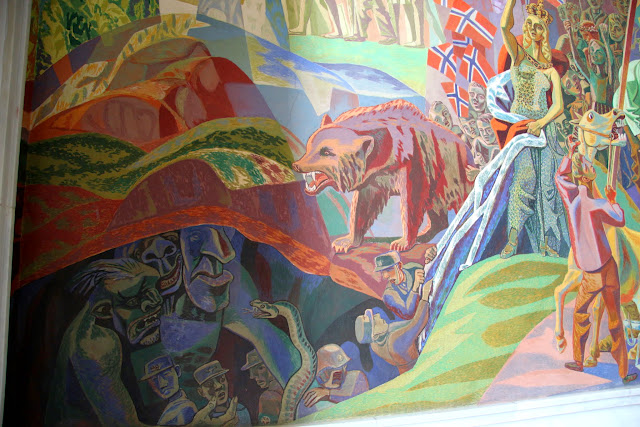
German soldiers hide from the Norwegian people in a cave, along with a troll and snake.
German conspirators depicted in the main hall of Rådhuset in Oslo
The artwork is of course not dominated by World War II. It merely reflects that in 1950 it was a fresh and critical experience that was a catalyst for a stronger Norwegian national identity. The building is full of beautiful rooms and spaces that celebrate other aspects of the Norwegian society and sense of self, as well as provide needed space for the ceremonies and functions that are called for in the capital's city hall (including the Nobel Peace Prize ceremony). The main hall, shown below, is a clear echo of Stockholm's Blue Hall but takes a much different approach. While Stockholm's hall is marked by a decision to allow the walls to remain unadorned, the Oslo space is covered in art.

One of the walls is covered with a depiction of Norwegian industry and work, while the other portrays civil society.


At one end of the hall is also the mural below. The mural focuses on emergence of socialism in Norway, the reasons that caused citizens to take action, and the vision for the future. On the left, is the depiction of a society still rooted in aristocracy, patronage, and the ills of the poor being left behind. In the middle, there is the emergence of labor and socialism. Norway for much of its existence has been a society based on fishing and subsistence farming. Hardly industries that generated immense wealth. It is a hard place to live and there were no vast riches to be had (at least until oil was discovered).

The signs in the middle have such radical demands such as the eight hour work days, a Norwegian social security system, vacation for workers, and voting rights for woman. It is worth noting that these things, both in Norway and in other places like the United States, were the result of the labor movement and that these were not free. In the background, you can see men on horses beating the demonstrators. This was not a scene unique to Norway.

The future? Home, health, prosperity, and security in old age for all.

Another especially powerful room follows the pattern of presenting two contrasting themes is the room below. Visually, the dimensions of the create a sense of towering and intimacy that is not found elsewhere in the areas I visited. The single thin window provides natural light, but accents the height of the room.

On each wall are two different stories of Norwegian society: The city and the country.

On one wall, we have Oslo during the winter. It is an urban cityscape that is both an idealized city, but also hides a variety of sub-stories in the imagery. The one that grabbed me is the view into the window of one of the apartments behind the men with skis. There is a woman and man who very obviously have just been fighting. She has her face in her hands while he looks out the window with his back to her. It's a very human scene and the choice to include it is interesting to me: Here, in an official building, we have an example of human fallibility and pain in a mural that otherwise presents a rosy picture of city life. The contrast makes it noteworthy, in my opinion.

On the other wall, we have the country side. The mural highlights the workers of the land, natural beauty, and an agrarian ideal. The expression of the cow below was my favorite part, although there was also some reference at the top that bugs in the countryside can be... large. One of them is depicted as being stabbed with a very large stick.


That's it for Oslo's City Hall (Rådhuset). Next Stop? How about a walk around town and some lunch?


Sunday, June 14, 2015

8 Hours in Oslo - First Stop: Operan!

Norwegian is the only carrier that is seriously competing for the West Coast to Scandinavia market right now and when I had a short notice need to head to Scandinavia I called on them again. With the pricing, it made sense to stop over in Oslo and have an afternoon in the city.


It would be a short 8 hours, but Oslo isn't that big of a city and most of the things that I was interested in this time around were in the central city. Ideally, I would love to be here in the summer and to have enough time to go out to the islands on the fjord for a little swimming, but wrong season and not enough time.


First stop was the Oslo Opera House. It is a new addition to the city I was last there, so I wanted to take a look. It sits regally on the water, like an iceberg that has hit land and crystallized. In reality, it's made of Italian white marble, oak, and glass. This was not a building built on the cheap.

One of the most engaging aspects of the building is that the exterior is completely open to the public. The roof is designed to let you walk, sit, or lay on it as the weather permits and as you like. From the top, there is a little view, but nothing too dramatic


Next stop? The Oslo City Hall.

Monday, January 19, 2015

Photos from Stockholm

 My last trip to Sweden was a bit of a personal trip. I was there to see friends and family, and my schedule didn't allow for very many photos. From the moment that I landed in Stockholm, it was pretty much non-stop: A dinner at a friend's house an hour and a half after touch down; Visiting family out in Stockholm; Visiting friends; Meeting their new families; Catching up with more friends; Spending time with three generations of family members outside of Stockholm. It was a whirlwind.

Still, I manage to get a few photographs in. Stockholm is a very, very nice city. Whether you want to measure it in terms of beauty, livability, or how well things just work, it is hard not to look around and wish that your city back home was as nice as it is here.

It really is too bad that you can't be in more than one place at once...